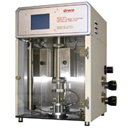

The Grace Instrument M5600 HPHT Rheometer is a true Couette, coaxial cylinder, rotational, high pressure and temperature rheometer (up to 1,000 psi and 500 °F). It is engineered to measure various rheological properties
of fluids, including n’, k’ and viscosity.
The M5600 HPHT Rheometer is also available with an optional viscoelastic
module for perfoming oscillatory tests to derive G', G”, G* and phase angle. This vastly increases the
researcher’s ability to predict the behavior of fluids, such as their capacity for suspending and carrying solids (weight material sag, drill cuttings transport,
proppant transfer, etc.).
The M5600 HPHT Rheometer incorporates a direct drive between the bob shaft and the torque transducer, which eliminates momentum of inertia errors associated with magnetically coupled torque transducers. The patented design
also eliminates bob shaft bearings, allowing the torque
transducer to respond quickly and consistently to
changing bob shaft torque.
- The M5600 HPHT Rheometer is completely compliant to API 13 & 39 specified geometry.
- It incorporates a direct measurement torque transducer and a separately controlled strain mechanism, which eliminates momentum of inertia errors. These errors are often associated with magnetic coupling across a pressure vessel wall in a typical rheometer under high temperature and high pressure conditions.
- The patented design also eliminates bob shaft bearings, allowing the torque transducer to respond quickly and consistently to changing bob shaft torque, even when testing acidic samples.
- The M5600 HPHT Rheometer enables tests to obtain values for G' and G", N' and K', all with the same API geometry.
- Hastelloy C construction on wetted parts and multiple patented technologies enable it to test the most corrosive samples, including acids.
- M5600 PC™ software allows both single- and multi-step real-time testing.
Standard rotational testing measures fluid viscosity under constant shear rate (constant speed), which indicates only apparent viscosity, or how thick a fluid is. On the other hand, almost all drilling muds, fracturing fluids and cements have some "gelly" strength that enables them to suspend solid particles. This ability to suspend solids is very important to many oil field operations. The M5600 HPHT Rheometer oscillatory testing option provides the capability to measure how "gelly" a sample is, in addition to how thick the sample is, by providing G', G", and other data. This vastly increases the researcher’s ability to predict the behaviors of these fluids, such as capacity for carrying solids (weight material sag, drill cuttings transport, proppant transfer, etc.). Oscillatory testing mode also completely removes measurement errors due to sample climbing.
The M5600 HPHT Rheometer features patented technology that can directly measure the true viscoelasticity of a sample under high temperature & high pressure conditions without magnetic coupling-induced measurement errors.
The M5600 HPHT Rheometer unit comes equipped with an API 39 standard size rotor and bob, designated "R1B5", or rotor 1, bob 5. The B5 bob is very commonly used for fracturing fluid testing. To reduce sample climbing ("Weisenberg effect"), extended bobs, such as the XB5 and XB2 are recommended for testing crosslinked fluids or high molecule structure samples. For drilling fluids testing, we recommend the B1 bob.
The M5600 HPHT Rheometer allows the user to test samples with high acid concentrations, including fluids with 30% HCl.
All wetted materials are Hastelloy C276 construction.
The M5600 HPHT Rheometer incorporates years of research into its innovative design:
- oil or dry heat option
- no bob shaft bearings
- direct-coupled torque transducer
- automatic
- fully digital
- LCD display
- PC Interface
- test flexibility
- fast test cycle:
setup-load-test-clean - repeatable results
- low maintenance
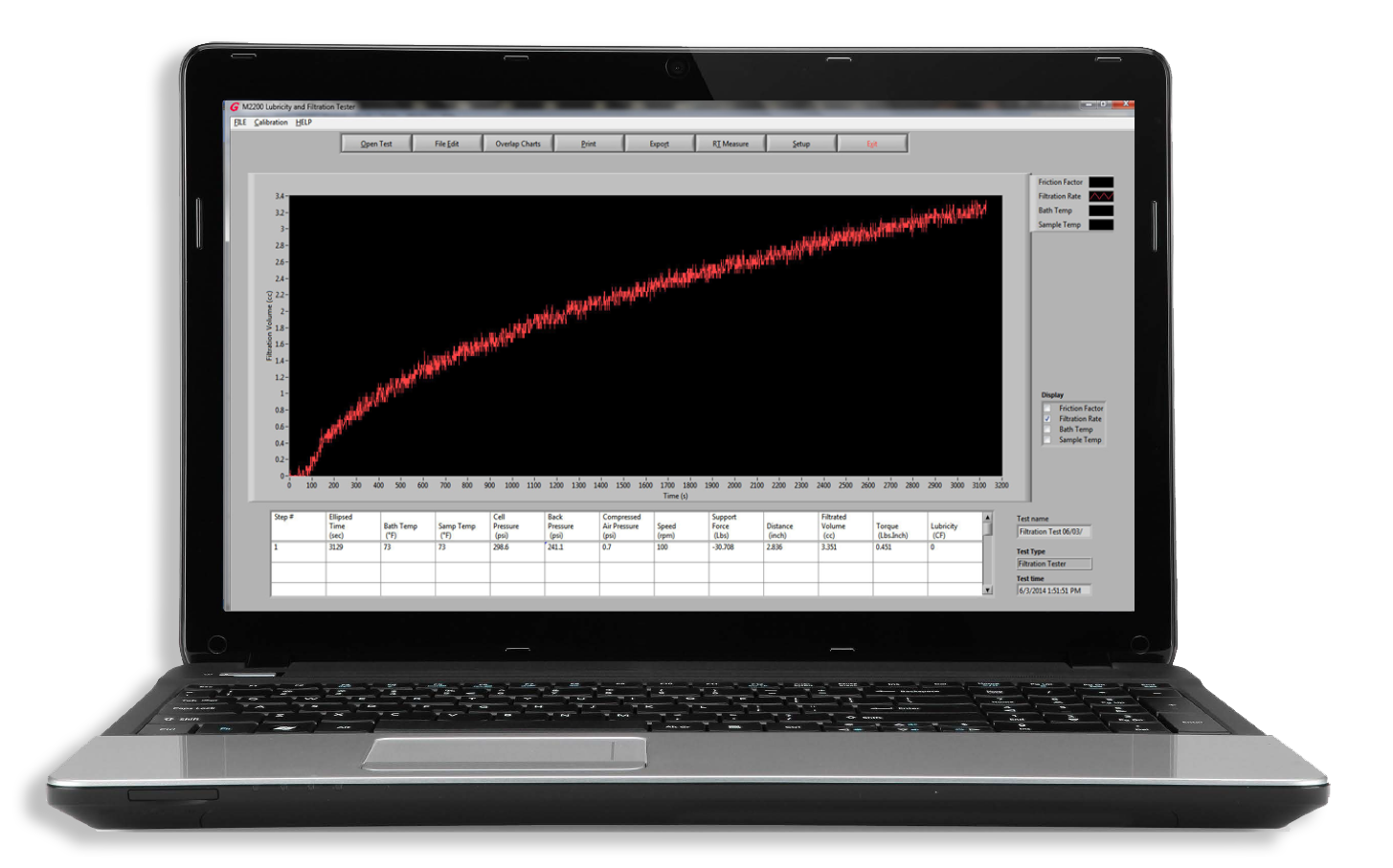
The M5600 HPHT Rheometer includes M5600 PC software, which connects the M5600 with a Windows-based PC
|